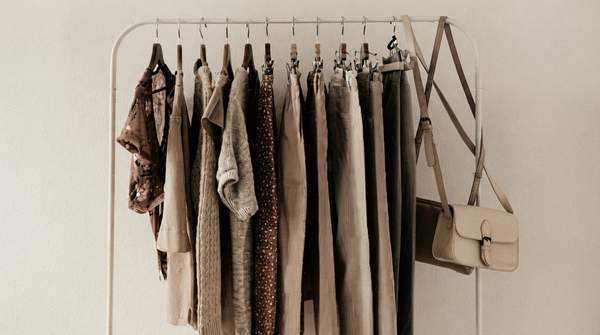
Start with four principles, not a shopping list. A capsule wardrobe is a small collection of versatile, interchangeable, well-made clothes that work together, and every garment you keep should earn its place by being versatile, timeless, high-quality, and true to your personal style. The concept traces back to London boutique owner Susie Faux in the 1970s and was popularized by Donna Karan's 1985 "Seven Easy Pieces" collection. Below, you'll find the history, the principles, and a repeatable decision framework you can apply to any item in your closet.
What is a Capsule Wardrobe?
A capsule wardrobe is a deliberately small collection of clothes designed to cover your real life. When the concept appeared in the 1970s, it was intended as a set of timeless, versatile pieces that would keep a person properly dressed for any occasion, as Fernanda Vazquez explains in her guide to year-round capsules. The modern seasonal versions are an adaptation of that original idea, not the definition.
Size is flexible. Most capsules run around 30 to 40 versatile pieces, according to registered dietitian and writer Elle Penner, but there is no right or wrong number—your lifestyle, climate, and laundry routine may call for more or fewer. What defines the capsule is not the count but the cohesion: every piece combines with the others.
The payoff is practical. Penner notes that a capsule wardrobe saves time and money, reduces decision fatigue, encourages more intentional and sustainable shopping, and lets you invest in high-quality pieces you'll wear for years. Courtney Carver, creator of the Project 333 minimalist fashion challenge, puts it simply: most of us already have a capsule wardrobe, wearing our favorite things over and over—we just have to sort through everything else to reach them.
The Origins of the Capsule Wardrobe: From Boutique to Runway
The term was coined by Susie Faux, a London boutique owner and wardrobe consultant, in the 1970s. Multiple accounts agree she was frustrated by the lack of well-made clothing and used "capsule wardrobe" to describe a small collection of versatile, interchangeable pieces built around quality basics. One note of uncertainty: Carver writes that the term actually originated in the 1940s and that Faux revived it in the 1970s, while other accounts credit Faux with coining it outright. Either way, Faux is the figure who brought the modern concept forward.
The idea went mainstream a decade later. In 1985, designer Donna Karan launched "Seven Easy Pieces," widely described as the first capsule collection. Karan's own brand history describes the collection as founded on an intuitive understanding of a woman's needs, intended to take her from day to night, home to office, and weekday to weekend.
The seven pieces themselves, as listed by Donna Karan's brand account and corroborated by vintage retailer MRS Couture, were a bodysuit, a tailored jacket, a skirt, pants, a cashmere sweater, a leather jacket, and an evening look. MRS Couture describes them as meant to be worn interchangeably—a revolutionary idea at the time, giving working women the freedom to look professional without feeling stuffy. Business of Fashion, quoted by Audrey Stanton, characterized a capsule collection as a condensed version of a designer's vision that transcends seasons and trends by being functional.
The Four Core Principles of a Capsule Wardrobe
Vazquez offers a useful reframe: a capsule isn't a closet full of boring basics. A "wardrobe basic" can be any item that meets four tests—and the same jacket can be a basic for one person and a statement piece for another. The principles are the constant; the garments are personal.
- Versatility. The item combines easily with many other pieces in your wardrobe, maximizing outfit combinations and letting it be dressed up or down.
- Timelessness. The piece is not particularly trendy. Carver contrasts this with trendy pieces worn for only one season; timeless items stand the test of time and can be worn for years.
- Quality. The garment is well-constructed and durable. Investing in quality reduces the need for frequent replacements and supports a more sustainable approach to clothing.
- Personal style fit. The piece reflects your style—boho, classic, rock, business casual, or whatever yours is. There is no one-size-fits-all capsule.
Notice that quality functions differently from the other three: Vazquez describes a basic as an item that "sets the quality level for the rest of your wardrobe," meaning one strong piece raises the bar for everything you add afterward.
Modern Approaches to Capsule Wardrobes
Contemporary methods adapt the same principles to different goals. The year-round capsule follows Faux's original intent most closely: one collection of timeless, versatile pieces that covers all occasions, with seasonal capsules as the modern variation, as Vazquez explains. Penner's guide similarly suggests a capsule should ideally be versatile enough to accommodate every season.
The seasonal capsule rotates a smaller set of clothes every few months. Vazquez notes that many people, including herself, first encountered the concept through Project 333 and assumed capsules were seasonal by definition—when in fact that is the newer interpretation.
The 5-4-3-2-1 method adds a numerical structure: choose roughly 15 items, for example five shirts, four bottoms, three dresses or suits, two pairs of shoes, and one jacket. The Oliver Charles guide, which describes this method, notes that variations exist based on personal preferences, but the underlying principle is always a small, fixed set of mix-and-match items. Whichever structure you choose, the goal remains a curated, functional wardrobe rather than a rigid formula.
Your Capsule Wardrobe Decision Framework
Use this matrix to evaluate any single garment. Answer each diagnostic question honestly, then tally your results to reach a keep, consider, or discard decision. The four tests come directly from the core principles, with Vazquez's observation that the same item can score differently for different people.
| Principle | Diagnostic question | Pass | Fail |
|---|---|---|---|
| Versatility | Does it combine easily with at least several other pieces I already own, and can it be dressed up or down? | It pairs widely and shifts between contexts. | It matches only one or two items, or suits a single occasion. |
| Timelessness | Would I still reach for this in two or three years, or is it tied to a single season's trend? | It's classic, not particularly trendy. | It's a trend piece likely worn for one season. |
| Quality | Is it well-constructed and durable enough to be worn for years? | It sets or matches the quality level of my wardrobe. | It would need frequent repair or replacement. |
| Personal style | Does it genuinely reflect my style and make me feel like myself? | It fits my style clearly. | It belongs to a style I admire but don't actually wear. |
Scoring: Keep the garment if it passes all four tests. Consider it if it passes three, especially if the failing test is versatility—sometimes one more complementary purchase fixes that. Discard or set aside it if it fails two or more, or if it fails personal style outright, because no amount of versatility compensates for a piece you don't feel like yourself in.
One caution from the evidence: don't mistake "basic" for "plain." Vazquez is blunt that the idea of capsule wardrobes requiring boring clothes is simply wrong. A bold item can pass all four tests if it's well-made, durable, and unmistakably yours.
Curate Your Wardrobe, Define Your Style
By applying the core principles and the decision framework above, you can intentionally curate a versatile, timeless, and personal capsule wardrobe—starting with what you already own. Erin Ross's practical observation is encouraging here: most people already own half of their capsule wardrobe, and the real work is spotting the gaps and filling them intentionally rather than starting from scratch.
Work through your closet one garment at a time with the matrix, then note which versatile, quality pieces could bridge the gaps between your keepers. Karan's seven pieces remain a powerful reminder that less really can be more: when clothes are chosen with strategy, they work together instead of competing.
The measurable indicator of success is a noticeable reduction in decision fatigue when choosing outfits, and a closet containing only items that are frequently worn and loved. If you're still sorting through clothes you never touch to reach the ones you love, the capsule isn't finished yet.
Sources
- How to Build a Capsule Wardrobe (My Go-To System + Checklist) — Modern Minimalism
- Our Brand — Donna Karan
- How To Create a Year-Round Capsule Wardrobe — Approximately Right
- What Is A Capsule Wardrobe? — The Good Trade
- 1985 Donna Karan "Seven Easy Pieces Collection" Black Wool Wrap Skirt — MRS Couture
- The Ultimate Guide On How To Start A Capsule Wardrobe — Be More with Less
- Capsule Wardrobes: The Ultimate Guide - Oliver Charles