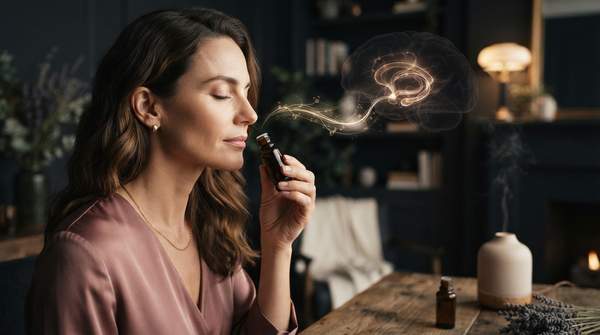
When you inhale an essential oil, volatile plant-derived compounds travel a defined route: they bind to receptors in your nasal cavity, send signals through the olfactory bulb, and reach limbic brain structures such as the amygdala and hippocampus. That pathway is the core scientific account of how aromatherapy is thought to influence mood and psychological processes. The mechanism is real and increasingly mapped, but the therapeutic claims built on it often outrun the evidence. This article traces the pathway step by step, then separates what studies support from what remains unsubstantiated.
The Olfactory-Limbic Pathway: How Essential Oils Reach Your Brain
Aromatherapy employs volatile plant-derived compounds to influence physiological and psychological processes through olfactory and peripheral pathways, as summarized in a Nature Index topic overview. Inhalation engages the olfactory epithelium, the tissue lining the nasal cavity that contains the receptors capable of detecting airborne molecules. From there, signals are transmitted through the olfactory bulb, a relay structure at the front of the brain, onward to limbic structures involved in emotion and memory.
The destination matters as much as the route. The limbic structures receiving these signals include the amygdala, the hippocampus, and the anterior cingulate cortex, according to the same summary. These regions are central to emotional processing and memory formation, which is why a scent can feel emotionally immediate in a way that a visual or auditory cue may not. A 2021 review of essential oils in mood disorders, published in the International Journal of Molecular Sciences by researchers at The Hong Kong Polytechnic University, describes the interplay between the respiratory system and the central nervous system as the route through which inhaled essential oil molecules exert effects on mood disturbances.
The Olfactory-Limbic Pathway: A Step-by-Step Model
Trace a single aromatic molecule through the sequence below. Each step builds directly on the one before it, and the final step is where the proposed effect on mood arises.
| Pathway Step | What Happens | Brain Region or Effect |
|---|---|---|
| 1. Inhalation | Volatile plant-derived compounds are breathed into the nasal cavity and reach the olfactory epithelium. | Nasal cavity; the entry point for aromatherapy via the olfactory system |
| 2. Receptor binding | The volatile molecules bind to specific receptors in the olfactory epithelium, initiating a neurological signal. | Olfactory receptors in the nasal cavity |
| 3. Signal transmission | Activated receptors transmit signals along the olfactory nerve to the olfactory bulb, which acts as a relay station. | Olfactory bulb |
| 4. Limbic processing | The olfactory bulb relays signals to limbic brain regions, where they are proposed to influence emotional and memory-related processing. | Amygdala, hippocampus, and anterior cingulate cortex |
The value of this model is that it makes the mechanism concrete rather than mysterious. An essential oil does not need to enter the bloodstream or cross into the brain directly to affect mood; instead, the scent itself is the signal, and the brain's own circuitry does the interpreting. That said, the model describes a proposed route of influence, not a guaranteed outcome for any particular oil or product.
Supported Effects: Anxiety Reduction and Mood Influence
What does the evidence say happens at the end of that pathway? The 2021 Polytechnic University review reports that essential oils, as the main component of inhalation therapy, have been widely investigated for therapeutic effects, and that evidence indicates essential oils can successfully reduce anxiety and relieve pain when combined with conventional treatment. The review's keywords, "anti-depression" and "anxiolytic," reflect the two mood-related effects that anchor the existing literature.
Importantly, the authors frame these findings across both human clinical and animal studies, and they conclude by discussing the antidepressant and anxiolytic effects of essential oils observed in both settings. That is a meaningful level of support: anxiety reduction in particular has enough experimental attention to be treated as a plausible, evidence-backed effect of inhalation-based aromatherapy when used alongside conventional care. It is not, on the current evidence, a standalone treatment for a diagnosed condition.
Beyond the Nose: Broader Physiological Mechanisms
Olfactory signaling is the clearest route, but it is not the only proposed mechanism. The Polytechnic University review states that through the interconnection of the respiratory system and the central nervous system, essential oil molecules exert effects on mood disturbances "via different possible routes." At the cellular and molecular level, the authors identify alteration of monoamines, neurotrophic factors, and neurogenesis as potential mechanisms underlying the therapeutic effects of essential oils.
Read that list carefully: these are candidate mechanisms, not confirmed ones. The review's own conclusion calls them "potential mechanisms," and the authors state that isolating the effective components of essential oils would be essential in future studies to dissect the precise underlying action. In other words, science currently knows that signals reach limbic structures and that anxiety-related effects appear in studies, while the deeper molecular explanation is still being worked out. This is normal for an active research area, and it distinguishes honest uncertainty from a failure of the underlying science.
Distinguishing Evidence from Unsubstantiated Claims
The gap between mechanism and marketing is where beauty and wellness products most often go wrong. A product may state that essential oils "affect the limbic system" and imply, without saying, that this means proven mood benefits. The verified mechanism supports only this: inhaled volatile compounds engage olfactory pathways that relay to emotion-related brain regions, and studies reviewed in 2021 support anxiety-reducing effects when combined with conventional treatment.
The 2021 review is explicit about the boundary: further evidence is needed to support the use of essential oils in the clinical treatment of mood disturbances, and exploring the underlying mechanisms may provide insight into future therapeutic use. Claims that essential oils cure, treat, or reverse medical conditions are not supported by this literature and go beyond anything the mechanism itself implies. A pathway to the amygdala is not a license for therapeutic promises.
Informed Choices: Evaluating Essential Oil Claims
When considering essential oils for mood or emotional well-being, prioritize products and claims that align with the scientifically supported olfactory-limbic pathway and documented anxiolytic effects, rather than unsubstantiated therapeutic or "curing" claims. A scent-based pathway is plausible; a cure claim is not.
The measurable check: a product's marketing materials or the scientific literature it cites should explicitly reference the olfactory-limbic pathway or cite studies on anxiolytic effects, rather than making broad, unsupported health claims. If a label connects a specific mechanism to a specific studied effect, the claim is at least anchored in the science; if it promises to treat a condition outright, it has stepped past what the evidence supports.