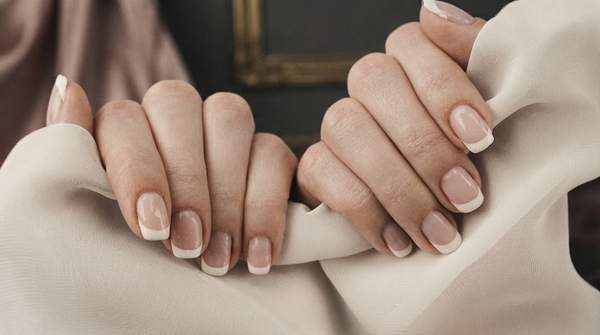
Who invented the French manicure? Not the French. The pink base and white tip were born in Los Angeles in 1976, created by Jeff Pink, the Israeli-born founder of the nail brand Orly. This year marks the look's 50th anniversary.
Why does that matter? Because the most famous manicure in the world began as a practical fix for a very specific problem: wasted time on film sets. It was only later that it got its glamorous name, and later still that it conquered the world.
Here is the full story, from a Hollywood supply store to Paris runways to today's reinvented versions.
The Hollywood Problem: A Practical Need for Versatility
Picture a 1970s film set. Quick-drying polish doesn't exist yet. An actress changes costume, and her nail color no longer matches. So she spends time in the chair getting her nails redone, over and over.
How much time? Up to an hour per change, according to reporting by Sara Spruch-Feiner for BeautyMatter, drawing on Pink's own account. Multiply that across a shoot, and the delays become expensive.
Pink knew this world well. In the 1970s he owned a beauty supply store that serviced a number of Hollywood studios, as he recounted to Allure's Elizabeth Gulino. He saw the problem firsthand: nails were costing productions time and money.
The industry, Pink has said, barely paid attention to nails at all back then. Beauty was centered on hair care and body care. Nails were an afterthought, and a logistical headache.
Jeff Pink's 'Natural Nail Look': The Birth of an Icon
So Pink went to the studios with an idea. In 1976, he began talking with Hollywood studios about creating a versatile, time-saving nail look for actresses who needed to move quickly between wardrobe changes, as Orly's own company history recounts.
His answer was deliberately simple. A neutral, natural-looking base. A clean white tip. A manicure designed to look like an exaggerated version of the natural nail, as Gulino describes it.
The point was subtlety. The look accentuated the nails without ever upstaging the outfit. One manicure could match every costume in the script. No more hour-long polish changes between scenes.
The director was pleased. Pink still remembers the compliment: "He got so excited and he told me, Jeff, one day you should win an Oscar because you saved the industry so much money," he told Allure. "I'm still waiting for that."
Pink's company immediately began producing the style as a kit called the "Natural Nail Look." The name was functional. The look was functional. The fame, however, was still years away.
From Hollywood to Paris: The 'French Manicure' Branding
Where does the "French" come in? Not from France. Pink took his natural nail look to the runways of Paris, where it found success with the fashion world.
After that runway moment, he renamed the kit the "French Manicure," as Orly's official history records. The Natural Nail Look became the Original French Manicure.
Consider the move. "Natural Nail Look" describes a technique. "French Manicure" evokes a place, a tradition, an entire aesthetic of elegance. The name change came after the Paris success, and it tied the product to the prestige of French fashion.
It was, in short, a marketing insight as much as a manicure. The look was invented in Los Angeles. The name was borrowed from Paris. And the borrowed glamour helped carry a practical Hollywood fix into the global beauty vocabulary.
A Slow Burn to Global Phenomenon: The Rise of the French Manicure
Did it take off overnight? No. Pink himself says it took years. "It would be a few years until it was called the French manicure, and until the look really caught on with the common nail lover," Gulino reports.
When did Pink realize it had become a cultural phenomenon? Asked that question by American Salon's Eileen Loh, he was precise: "By the late 80s, it was everywhere. ORLY was selling a lot of the kits, and other brands were starting to imitate it."
The look spread through television, too. Actresses wore the French manicure on shows like The Tonight Show Starring Johnny Carson, and talked about it when asked about their nails.
The commercial evidence backs up the cultural story. White Tips remains Orly's top-selling SKU fifty years on, as BeautyMatter reports. A product invented to save film productions money became the brand's single most enduring seller.
The French Manicure: A 50-Year Timeline
Use this chronology to trace the full arc, from the on-set problem to today's reinventions. Each row sequences a key development and shows why it mattered to the style's evolution.
| Year / Period | Development | What Happened | Why It Mattered |
|---|---|---|---|
| 1976 | Invention for Hollywood | Jeff Pink created the "Natural Nail Look" in Los Angeles: a neutral base with a white tip, designed so actresses could move between wardrobe changes without repainting. | A practical solution for film sets, offering a versatile, natural-looking base that saved productions time and money. |
| c. 1978 | Branding and naming | After the look's success on Paris runways, Pink renamed it the "French Manicure." | The new name capitalized on the association with French fashion and elegance, giving a functional kit a glamorous identity. |
| 1970s–1980s | Initial popularization | The style was not an instant hit. It spread gradually through stylists, starlets and the fashion world, and appeared on television. | It slowly built into a widespread cultural phenomenon, becoming a classic style that other brands began to imitate. |
| Late 1980s | Cultural peak | Pink recalls: "By the late 80s, it was everywhere." | The moment the niche Hollywood fix became a mainstream staple, with Orly selling kits at scale. |
| Late 1990s–2000s | Perception shift | The style became associated with exaggerated acrylics, thick white tips, and figures like Carmela Soprano, Playboy models such as Pamela Anderson and Carmen Electra, and the cast of The Real Housewives of Orange County. | Changing beauty trends and the thicker acrylic version led parts of the culture to see the once-classy look as "tacky" or dated. |
| 2010s–present | Modern resurgence | A renewed focus on nail art and refined, minimal interpretations, such as Jin Soon Choi's "invisible" French manicure. | The style's rebirth moved it away from the "tacky" perception and reestablished it as a creative template. |
Cultural Shifts: From Classy to 'Tacky' and Back Again
How does a symbol of elegance become a punchline? Gradually, then through acrylics. By the 2000s, the version most people saw was no longer Pink's subtle original.
Nail artist Jin Soon Choi, speaking to Allure, points to the shift. The cast of The Real Housewives of Orange County, which premiered in 2006, mostly wore long acrylic nails in "a very extreme square shape" with thick white smile lines across the tips.
"By the 2000s, that exaggerated version became much more common," she says. "The same basic French manicure had become a completely different look." That, in her view, is what made the style appear "tacky" to some.
The problem, she explains, was the execution, not the concept. "[With acrylics] the finish is not as smooth, it's way too thick," she says. "[People] tried to copy all celebrities that did thick lines."
The cultural associations piled on. Maybe it was the manicure's permanent placement on mob wife Carmela Soprano's fingernails, Allure muses, or its constant appearance on Playboy Bunny's hands, or its ubiquity at prom nights across the country.
The Enduring Legacy: Reinvention and Modern Adaptations
So how did it come back? Through artistry. "It was really the focus on nail decoration, and the idea of nails as an art form, that helped steer the conversation away from it being tacky," Choi told Allure.
Over the last ten years, the French manicure has had what Gulino calls a rebirth. Celebrities can't get enough of the style. Today's Allure staffers no longer agree with their predecessors' dismissal.
The reinventions keep coming. Choi's own "invisible" French manicure strips the look down to a whisper of the original. Nail artists have transformed Pink's template into an endlessly adaptable global style, as BeautyMatter notes, playing with shapes, colors and artistic elements.
Fifty years on, the white tip survives because it works as a framework, not a fixed formula. What began as a time-saver for wardrobe changes ends up as a canvas for creativity.
The Enduring Appeal of a Reinvented Classic
The decision for you as a reader of beauty history: treat the French manicure not as a dated trend but as a foundational, adaptable style whose perception has cycled from classy to "tacky" and back, and whose capacity for reinvention is the reason it endures.
The measurable indicator to watch is the continued emergence of new "French" variations in beauty trends and celebrity styles. That is exactly what the past decade has delivered, from Choi's invisible French to the flood of reworked tips on celebrity hands. As long as nail artists keep producing fresh interpretations of Pink's 1976 template, the fifty-year-old Hollywood time-saver remains, by its own evidence, very much alive.