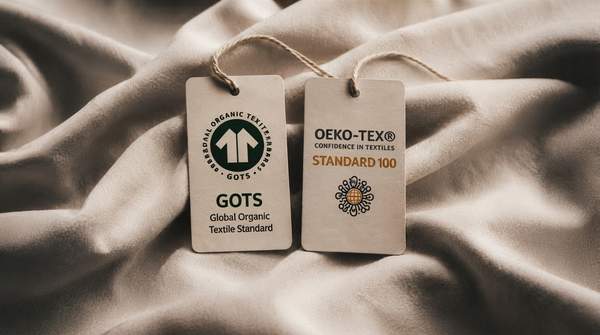
Not all sustainable fashion labels promise the same thing. The Global Organic Textile Standard (GOTS) verifies that organic fibres are tracked from farm to finished product, alongside environmental and social criteria. OEKO-TEX Standard 100, by contrast, tests the finished product itself for harmful substances that could affect human health. Once you understand this distinction—organic integrity across the supply chain versus chemical safety at the end of it—you can read a garment label and know exactly what you are, and are not, being promised.
How Fashion Certification Systems Work
A certification is a specific benchmark that an independent third party checks a company against. That third-party involvement is what separates a genuine certification from a brand's own sustainability claims or from voluntary industry initiatives. As Project Cece's guide to sustainable fashion certifications puts it, when specific benchmarks are set and a third party gets involved, you can place real trust in the label.
This distinction matters because not every sustainability scheme certifies anything. A FutureLearn course on sustainable fashion notes that standards can be certified against, while other schemes and initiatives may rely on voluntary codes, offering support and collaboration rather than verification. A brand can belong to a well-intentioned initiative without ever having been audited against a fixed benchmark.
Certification bodies also differ in what part of the production process they cover. Textile Exchange, which develops and owns a family of material-specific standards, describes its system as one of supply chain verification—for example, its Content Claim Standard gives companies a means of verifying that specific raw material inputs are actually present in the final product. Some certifications trace materials through every stage of production; others test only the finished article. The rigour, frequency and scope of verification varies significantly between standards, so the presence of any label is the beginning of your assessment, not the end of it.
Global Organic Textile Standard (GOTS): Organic Integrity
GOTS is one of the most recognised certifications in fashion, and its defining feature is breadth. According to SustainabilityTracker.com's guide, GOTS is best suited to organic fibres and full supply chain verification: it tracks organic fibres from farm to finished product and includes environmental and social criteria alongside that material tracking.
What this means in practice is that a GOTS label speaks to two things at once. It covers material integrity—the organic status of the fibres—and it covers working conditions in production. As SustainabilityTracker.com frames it, GOTS matters because it covers both material integrity and working conditions, "not just one or the other." That dual scope is unusual among consumer-facing labels, and it is the main reason GOTS functions as a whole-chain certification rather than a single-point test.
For you as a shopper, the practical guarantee is this: when you see GOTS on a garment, the claim being made is about the entire journey of the fibre, from how it was grown through how the product was made, including the environmental and social conditions along the way. It is not primarily a claim about the chemical safety of the finished fabric, even though its production criteria touch on processing.
OEKO-TEX Standard 100: Chemical Safety Assurance
OEKO-TEX Standard 100 answers a different question: is this product safe to wear? The certification, run by the International OEKO-TEX Association and established in 1992, focuses on what is in the fabric, testing for harmful substances that could affect human health. SustainabilityTracker.com highlights its relevance for skin contact, noting it helps ensure clothing is safe to wear, especially for sensitive skin.
The scope of the test is thorough at the product level. As POMP's guide to sustainable fashion certifications explains, Standard 100 certifies that end-products are free from over 100 substances harmful to people and the environment, and that every component of the product is covered. OEKO-TEX is one of the most recognised certifications for textile safety.
But there is a boundary you should understand clearly. POMP cautions that OEKO-TEX "is not to be confused with an organic certification; it guarantees that an end product is free from harmful substances." In other words, an OEKO-TEX Standard 100 label tells you nothing about whether the fibres were grown organically, nor does it verify the environmental or social conditions under which the product was made. Its guarantee is real, but it is confined to the finished article you hold in your hands.
Certification Comparison: GOTS vs. OEKO-TEX Standard 100
The table below categorises each certification by its primary domain and the extent of its supply chain coverage, so you can match a label to your own priority at a glance.
| Certification | Primary Focus | What It Guarantees | Supply Chain Scope |
|---|---|---|---|
| Global Organic Textile Standard (GOTS) | Organic status of textiles, plus environmental and social criteria | Organic fibres tracked from farm to finished product, with working conditions covered alongside material integrity | Full supply chain, from harvesting of raw materials to the finished product |
| OEKO-TEX Standard 100 | Chemical safety of the finished product for human health | Every component of the end product is free from over 100 substances harmful to people and the environment | Primarily the final textile product; does not certify organic origin of materials or the environmental and social conditions of production |
Read side by side, the two labels answer different questions rather than competing ones. GOTS asks: was this made with organic fibres, under acceptable environmental and social conditions, at every stage? OEKO-TEX Standard 100 asks: is this finished product, in every component, free from harmful substances? A garment could carry one, both, or neither—and each combination tells you something distinct.
Choosing Certifications Aligned with Your Values
Consumers should identify their primary sustainability concern—organic materials, chemical safety, or social welfare—to select products bearing the most relevant certification. If your priority is organic fibres and ethical production throughout the supply chain, look for the GOTS label. If your priority is a product free from harmful substances, particularly for sensitive skin, the OEKO-TEX Standard 100 label is the relevant signal.
One caution before you treat any label as the whole story. Tripulse, a brand that holds certifications itself, reminds shoppers that labels are only part of the picture, and encourages seeking true transparency by looking for clear information on a brand's website and asking questions directly. A missing label does not prove a brand is unsustainable, and a present label does not cover everything.
The measurable indicator to use when you next shop is simple: the presence of a GOTS label indicates a focus on organic and ethical production throughout the supply chain, while an OEKO-TEX Standard 100 label signals a product free from harmful substances. Check the label, match it to your priority, and you will know precisely what your purchase is being certified to deliver.
Sources
- Guide to Sustainable Fashion Certifications - SustainabilityTracker.com
- Simple Guide to Sustainable Fashion Certifications | Sustainable Fashion Blog| Project Cece — Projectcece
- Futurelearn
- Standards - Textile Exchange
- The Periodic Table of Sustainable Fashion Certifications — POMP MMXIX
- 7 Sustainable Fashion Certifications You Need to Know (and why!) — Tripulse