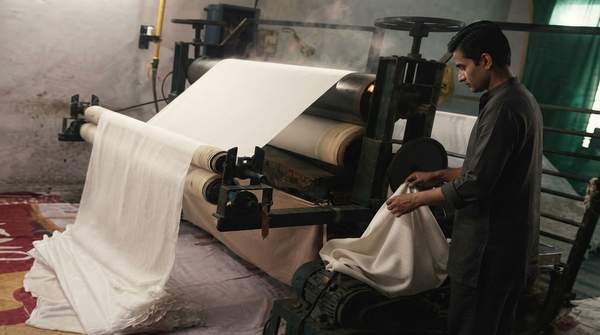
Every finished garment has been through more than a loom. Before fabric becomes a shirt or a pair of jeans, it typically passes through finishing steps that change how it looks, feels, and behaves. Three of the most common are mercerization, sanforization, and calendering — and each works in a fundamentally different way. Mercerization is a chemical treatment that swells cotton fibers to boost luster, strength, and dye affinity. Sanforization is a mechanical pre-shrinking process that compresses fabric so it holds its size after washing. Calendering is a pressure-and-heat process that smooths and condenses fabric for a refined surface. Understanding the differences helps you judge quality before you buy.
Understanding Fabric Finishing: Beyond the Loom
Fabric comes off the loom as greige material — usable but unfinished, with residual tension in its yarns and a rough, uneven surface. Finishing is the stage where that raw textile gains its final character. Some finishes rely on chemistry, others on physical force, and the two routes produce very different results. A chemical finish changes the fiber itself, while a mechanical finish reshapes or repositions what is already there.
Why does this matter to you as a shopper? Because the finishing a fabric receives largely determines how it will look after ten washes, not just on the rack. Industry guides describe finishing as the path "from greige to gorgeous," the step that turns stable, refined cloth out of raw woven material. The three finishes covered here each solve a different problem: dullness and weakness, unpredictable shrinkage, and roughness.
Mercerization: Enhancing Cotton's Luster and Strength
Mercerization is a chemical process, and it applies specifically to cotton. The fabric is treated with caustic soda, which causes the cotton fibers to swell. That swelling is the whole secret of the finish: it alters the structure of each fiber, and the reshaped surface reflects light more effectively, producing the signature sheen associated with mercerized cotton.
Textile industry descriptions of the process list three benefits that arrive together: increased luster, increased strength, and improved dye affinity. The last one is easy to overlook but matters for how a garment ages. Because mercerized cotton takes dye more readily, colors come out more vibrant — and the resulting fabric is described as more durable, which is why mercerization is a popular choice for high-quality garments. If you have ever wondered why some cotton shirts have an almost silky glow while others look flat, mercerization is usually the answer.
Sanforization: The Mechanical Path to Shrink Resistance
Sanforization solves a different problem: the fabric shrinking unpredictably in your washing machine. Its formal name in the textile industry is the Controlled Compressive Shrinkage process, and according to a textile research write-up on residual shrinkage control, it is a purely mechanical treatment with no chemicals added. The word "Sanforized" comes from the name of its inventor, Sanford Lockwood Cluett, who patented the process in 1928.
The mechanism is straightforward once you understand why fabric shrinks at all. During weaving, tension is stored in the fabric's yarns. That stored tension is latent shrinkage, and it does not disappear until the fabric is washed. The sanforizing process forces the fabric to give up that stored length before it ever reaches the garment stage: the cloth is compressed between a thick rubber blanket and a heated cylinder, physically pushing the yarns closer together in a controlled, repeatable way. In effect, the fabric is pre-shrunk at the mill rather than in your laundry.
The result is held to a measurable standard. After the compressive shrinkage process is complete, a fabric sample is wash-tested, and it must meet the sanforized standard for both length and width before it can carry the sanforized label. Cotton and cotton-rayon blends are described as particular beneficiaries, since the process helps the final product maintain its size and fit.
Calendering: Smoothing and Compressing for a Refined Finish
Calendering is also mechanical, but it targets the fabric's surface rather than its dimensions. Textile finishing guides classify it as a stabilization process used to smooth or compress fabric. The fabric is passed through large, heated, pressurized rollers, which condense the fabric's fibers.
Think of it as ironing at an industrial scale: heat plus pressure flattens and compacts the surface, giving the cloth a smoother, more polished hand and appearance. Unlike mercerization, which works on cotton specifically through chemistry, calendering's effect comes purely from the mechanical action of the rollers and can be understood as a physical pressing of the fabric's structure. Where sanforization changes how the fabric behaves in the wash, calendering changes how it presents to the eye and hand.
Comparative Guide to Fabric Finishing Processes
The table below contrasts the three processes side by side. The key distinction to hold onto is the mechanism: one is chemical, two are mechanical — and among the mechanical pair, one compresses to prevent shrinkage while the other presses to smooth the surface.
| Process | Mechanism | Primary Effect | Fiber-Level Change | Commonly Treated Fabrics |
|---|---|---|---|---|
| Mercerization | Chemical — treatment with caustic soda | Increased luster, strength, and dye affinity; more durable, vibrant fabric | Cotton fibers swell, altering fiber structure and enhancing light reflection | Cotton |
| Sanforization | Mechanical — compressive shrinkage via rubber blanket and heated cylinder; no chemicals added | Pre-shrinks fabric to control and reduce future shrinkage; must pass a wash test for length and width to carry the label | Yarns physically pushed closer together, releasing stored tension | Cotton and cotton-rayon blends |
| Calendering | Mechanical — large, heated, pressurized rollers | Smooths and compresses the fabric for a refined surface | Condenses the fabric's fibers | General woven fabrics |
Read across the mechanism column and the pattern is clear: each process attacks a different weakness. Mercerization remakes the fiber chemically for shine and strength; sanforization repositions the yarns mechanically for dimensional stability; calendering presses the whole cloth for smoothness. None of them substitutes for another, and a single quality garment may have received more than one.
Choosing Your Fabric: What Finishes Mean for You
When selecting garments, consider the finishing processes applied so you understand their inherent properties and expected performance. A cotton shirt with a subtle sheen and rich color likely owes it to mercerization. Denim or cotton trousers that fit the same after repeated washing were probably sanforized — the mill took the shrinkage so your washing machine could not.
The practical check is on the label. Look for "sanforized" on garment tags and product descriptions, since fabric must meet the wash-tested shrinkage standard for length and width before it may carry that label. "Mercerized" likewise signals a cotton that has been treated for luster and durability. If neither term appears on a cotton garment you expect to wash frequently, that absence tells you something too: the fabric may not have been pre-shrunk, and you can anticipate some change in size and fit over its first washes.
Sources
- A Guide to Fabric Finishes - From Greige to Gorgeous - Apex Mills
- Mercerization: Caustic Soda Treatment Increasing Cotton Luster — MsDressly
- Sanforizing Finishing and Working Principle of Sanforizing Machine — Textile Learner
- Optimization of Residual Shrinkage Control of 100% Cotton Woven Fabric Through Sanforization — Iris Publishers
- Sanforizing Guide: How to Control Shrinkage — iFactory AI
- Fabric Finishing Techniques: Enhancing Texture, Durability, and Aesthetics — Locofast