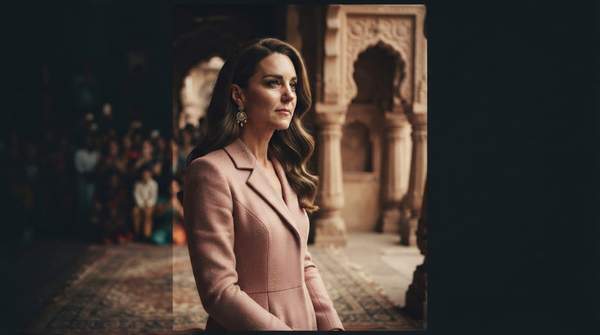
Princess Kate's November 2026 arrival in Mumbai delivered a compact masterclass in fashion diplomacy. Across her first day of the three-day state visit with Prince William, she wore two sharply different looks: a pistachio-green Veronica Beard blazer and a cobalt-blue Roksanda dress. The most diplomatically loaded detail, though, was small—a pair of lapis lazuli-and-diamond drop earrings by Amrapali, an Indian jewelry brand, which she first wore in Mumbai during her 2016 tour of India. As Harper's Bazaar reported, the earrings were part of a "colorful wardrobe" for the trip, and their return signals a deliberate thread connecting the two tours.
Princess Kate's Fashion Diplomacy: A Strategic Approach to Royal Tours
Royal tour wardrobes are rarely accidental, and Kate's approach has been well documented by fashion journalists. British Vogue, reviewing her 2016 India tour, described a wardrobe that "brought together the fashion heritage of both India and the country she represented." That tour included an Alexander McQueen dress with a paisley print drawing on the textile traditions of India and Persia, and a pink-and-pistachio tunic by Mumbai-based designer Anita Dongre, worn to play cricket with children supported by local charities.
The pattern is consistent: mix home-country designers with host-country ones, echo local textile traditions, and let the clothes do quiet cultural work. It is worth being clear about what this analysis rests on. These readings come from fashion journalism and the visible context of the items themselves—not from official palace statements. No royal household has published a memo explaining an outfit. But the repetition across a decade makes interpretation reasonable, and that is exactly what the 2026 Mumbai wardrobe invites.
The 2026 Mumbai Tour: Outfits as Diplomatic Statements
The 2026 visit was the couple's first joint tour in four years, and Kate treated the first day as two distinct statements. In the morning she stepped out in the fresh pistachio-green blazer from Veronica Beard; she then changed into the bright cobalt-blue Roksanda dress for later engagements. The Roksanda design featured a V neckline, structured sleeves with a bow-like detail on one shoulder, a belted waist, and a flowy skirt, styled with chocolate-brown accents: suede Gianvito Rossi heels and a small Hudson bag from DeMellier.
The diplomatic weight sits in the accessories and the re-wear. Roksanda is a London-based designer, so the dress kept one foot in the UK while in India. The earrings, by contrast, put Indian craftsmanship directly on display. Together, the two looks balanced representation of home with respect for the host nation—the same formula Vogue identified in 2016.
Outfit 2: Pistachio Green and Understated Elegance
The arrival look deserves its own reading. The pistachio-green Veronica Beard blazer, paired with matching wide-leg trousers and a white top, was vibrant, polished, and approachable—the visual equivalent of a warm greeting. Its inclusion in what Harper's Bazaar called a deliberately colorful wardrobe for the trip is consistent with Kate's broader pattern of using resonant color to make a positive visual impression on arrival in a host country.
Honesty requires a boundary here: no source attributes a specific, stated diplomatic intent to the green outfit itself. What the evidence supports is narrower and still meaningful. A bright, welcoming color on a first public appearance in Mumbai aligns with the strategy observers have tracked since 2016, when a pink-and-pistachio tunic by an Indian designer served a similarly sunny, accessible role. The 2026 green look echoes that palette a decade later—whether by design or instinct, the visual rhyme is there for anyone comparing the tours.
Diplomatic Threads: Kate's 2026 Mumbai Wardrobe Analysis
The table below isolates the diplomatic and cultural signals in each of the two documented 2026 outfits, comparing the origin and context of their key components. Use it to see how each look carried a different emphasis—one rooted in UK representation and Indian craftsmanship, the other in warmth and accessibility.
| Outfit | Key Diplomatic Element | Symbolic Message | Connection to Tour Context |
|---|---|---|---|
| Cobalt-blue Roksanda dress | Re-wearing Amrapali earrings, first worn at a Mumbai charity gala during the 2016 tour | Respect for Indian craftsmanship and acknowledgment of past cultural engagement | Directly links the 2026 visit to the 2016 tour, reinforcing continuity in the UK–India relationship |
| Cobalt-blue Roksanda dress (designer origin) | Roksanda is a London-based designer | Represents the UK's own fashion sector while visiting India | Continues the 2016 formula of blending home-country and host-country fashion heritage |
| Pistachio-green Veronica Beard blazer with matching trousers and white top | A vibrant, welcoming color chosen for her first public appearance on arrival | Warmth and approachability, interpreted from its place in a deliberately colorful tour wardrobe | Visually echoes the pink-and-pistachio Anita Dongre tunic from the 2016 Mumbai engagements |
Read side by side, the two looks split the diplomatic labor. The blue outfit carried the deeper message—Indian jewelry, re-worn a decade later in the same city, is a tangible gesture of remembrance and respect. The green outfit handled the first impression, projecting energy and openness before a single speech was made.
Continuity in Style: Echoes of the 2016 India Tour
The Amrapali earrings are the clearest evidence that 2026 was not a fresh start but a continuation. Kate debuted the lapis lazuli-and-diamond drops at a charity gala in Mumbai during the 2016 tour, and she chose them again for Mumbai in 2026. In royal-watching terms, a re-wear is never just thrift: it is a curated callback. By returning Indian-made jewelry to Indian soil, she honored local artisanship and quietly acknowledged the shared history of the two tours.
The 2016 benchmark makes the pattern legible. Then, as Vogue's Daniel Rodgers recounted, her wardrobe paired British labels like Alexander McQueen—whose paisley print drew on Indian and Persian textile traditions—with Mumbai-based designer Anita Dongre. The 2026 wardrobe repeats the structure: a London-based designer in Roksanda, an Indian jewelry house in Amrapali, and a color palette that rhymes with the earlier trip. Ten years apart, the formula holds.
The Enduring Impact of Fashion Diplomacy
Princess Kate's consistent and strategic use of fashion during royal tours, particularly evident in her 2026 Mumbai visit, serves as a powerful non-verbal communication tool to foster diplomatic relations and cultural understanding. The two documented outfits show how the strategy operates at different scales: a blazer sets a tone, while a pair of re-worn earrings can carry a decade of relationship-building.
For readers judging whether this reading holds, watch the measurable indicator: continued integration of local designers, re-wearing of culturally significant items, and incorporation of sustainability-focused accessories in future royal tour wardrobes. If the pattern is real, it will keep appearing—one Indian designer, one meaningful re-wear at a time.