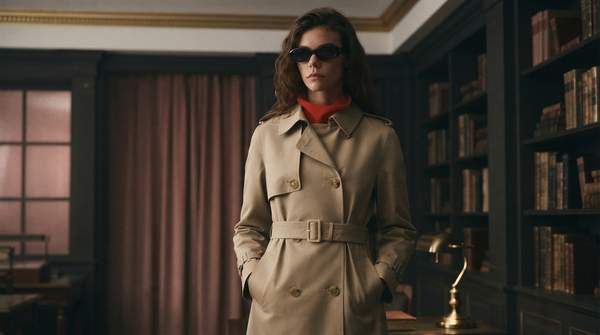
The trench coat's most distinctive features exist because soldiers needed them. The storm flap, the belt, the buckled cuffs, the deep pockets, the double-breasted front: each began as a practical solution to the misery of trench warfare, where officers faced rain, mud, and the need to carry equipment while staying mobile. When the war ended, returning officers brought their coats home, and the garment crossed into civilian life carrying its battlefield engineering intact. That engineering, not marketing, is what made it endure.
Anatomy of Function: Every Detail with a Purpose
What emerged from the First World War was, as Gloverall's history of the coat puts it, a coat that was "long enough to protect from rain and mud, short enough for ease of movement." The same account captures the design philosophy in a single line: "Everything had a purpose; nothing was purely decorative." The table below maps each signature element of the classic trench coat to its documented military function, so you can read the coat's history directly from its construction.
The Trench Coat's Functional Blueprint
| Design Element | Original Military Purpose |
|---|---|
| Double-breasted closure and wide lapels | The overlapping double layer of fabric provided extra warmth and weather protection across the chest, and the wide lapels could be raised and buttoned to shield the neck. |
| Belted waist | The self-belt cinched the coat for a snug fit that kept out wind and rain, and provided a place to hang additional equipment. |
| D-rings on the belt | Used to attach gear, keeping equipment accessible while the wearer stayed mobile. |
| Storm flap at the shoulder | Helped water run off the coat while adding ventilation. |
| Cuff straps | Buckled straps tightened the wrists, keeping water from running down the forearm when using binoculars in the rain and sealing out wind and cold. |
| Deep pockets | Designed to hold maps and other field essentials for officers. |
| Epaulettes | Functional in a military context, buttoning closed to secure items on the shoulder. |
| Raglan sleeves | Allowed greater freedom of movement. |
| Removable wool liner | Added warmth in the field and could double as emergency bedding. |
Two details deserve a closer look. The cuff straps illustrate how specific the military requirements were: the buckled straps existed partly to keep water from running down the forearm when an officer used binoculars in the rain. The removable wool liner shows the same logic extended to shelter: it provided warmth when needed and could serve as bedding in an emergency. Nothing on the original coat was ornamental.
From Military Surplus to Civilian Style
The transition from battlefield to wardrobe was unusually smooth. When the war ended, many officers returned home with their trench coats in tow, and the garment moved into city life without redesign. Its association with the heroism and fortitude of the war, combined with its inherent practicality and classic styling, made it a popular choice for both men and women almost immediately.
Popular culture then locked the association in place. The coat's appearance on Humphrey Bogart in Casablanca cemented its status as a lasting symbol of style, tying it to the film noir image of the trench-coated detective or exile. Over time, as Gloverall's account describes, the coat "quietly shed its martial edge to become a symbol of elegance, practicality, and understated British style." The coat never needed to change its essential design to make that journey; it only needed new contexts in which to be seen.
That is the remarkable part of the story. Many military garments were surplus after the war and most faded away. The trench coat survived because its functions translated: weather protection works on a city street exactly as it worked in a trench, and pockets that held maps hold everything a civilian carries. The coat became, in the words of one history of the garment, "a symbol of a certain kind of understated elegance, a garment that was both functional and fashionable."
The Enduring Appeal of Functional Design
Why did this coat outlast its military purpose? The answer lies in the relationship between form and function. Because every feature solved a real problem, the coat acquired a visual logic: each element looks like it belongs. Decorative fashion details date quickly because they answer no need; functional details persist because the needs they answer persist. Rain, wind, and the need to carry things did not disappear with the war.
The trench coat also benefited from versatility built into its original specification. It was designed as a windbreaker and rain jacket rather than a heavy winter coat, with an optional wool liner for warmth. That made it a three-season garment from the start, adaptable across climates and occasions. Its classic styling meant it could sit comfortably on a soldier, a film star, or a commuter without looking out of place in any of those roles.
The belt, the straps, the flaps, and the pockets also give the coat a level of visual interest that pure minimalism cannot achieve. Wearers respond to details that visibly do something. When you cinch the belt or buckle the cuffs, you are performing the same adjustments a wartime officer made, and the coat rewards you with a better fit and better protection. That tactile, working quality is why the design has been borrowed repeatedly across decades of fashion rather than replaced.
A Legacy Forged in Utility
The trench coat's enduring status as a fashion classic is a direct result of its original, highly functional military design, where every feature served a practical purpose. The synthesis is straightforward: the documented function of each element, combined with the historical record of the coat's post-war adoption, shows that its lasting style is a consequence of its utility, not an accident layered on top of it.
You can verify this claim yourself with a simple test. Look at any contemporary trench coat and count how many of the original elements remain: the belt, the double-breasted front, the storm flap, the buckled cuffs, the deep pockets. The continued presence of these original design elements in modern trench coat styles, even where their military function is no longer primary, is the measurable indicator of the design's success. A coat designed for the trenches is still being made essentially as it was engineered a century ago, and that persistence is the strongest evidence that functional design ages better than fashion.