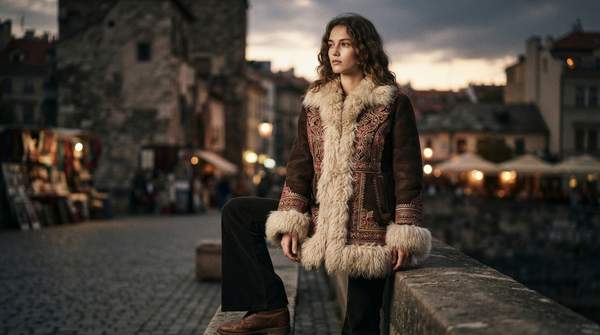
Before it was a "Penny Lane" coat, it was an Afghan coat. The shaggy, hand-embroidered sheepskin garment that resurfaces every winter in vintage fashion circles began as practical outerwear made in Afghanistan's Ghazni province, traveled to London on the 1960s hippie trail, and was renamed after a fictional character in the 2000 film Almost Famous. Understanding that journey means separating the coat's real origins from the pop-culture label that now often replaces them.
The Afghan Coat: A Garment of Deep Cultural Roots
You can't understand the coat without starting in Afghanistan. Afghan coats originate from Ghazni province, situated between Kabul and Kandahar, where the Pashtun people made them as a development of the traditional Afghan overcoat, which could range from jacket-length to ankle-length, with full or partial sleeves.
The materials were built for survival. Artisans crafted the coats from suede, sheepskin, goatskin, or leather, often lined and trimmed with fur to combat cold mountain winters. Reporting compiled by historian Tim Bonyhady describes coats usually made from the skin of karakul sheep, a breed native to Afghanistan, though bear, fox, and goat skins were also used. The production process itself was divided by gender: men cured, cut, sewed, and tanned the skins yellow with pomegranate rinds, while women embroidered them.
That embroidery is the coat's signature. Ghazni embroidery features geometric and floral motifs carrying cultural significance passed down through generations of craftswomen. Because each coat was hand-stitched rather than mass-produced, every piece was unique—an artisanal record, not a factory product.
The Afghan Coat's Journey: A Chronological Timeline
Tracing the coat's evolution reveals how a regional garment became a global fashion item, and how its name changed along the way.
| Period | Event | Location | Key Figures/Groups |
|---|---|---|---|
| 20th century (craft dates back further) | Traditional coat production: cured, tanned sheepskins with hand-embroidered geometric and floral motifs, made for warmth | Ghazni province, Afghanistan | Pashtun artisans; men tanned skins, craftswomen embroidered |
| 1960s | Afghanistan's modernisation programme brought the garment to wider attention outside the country | Afghanistan | Travellers on the "hippie trail" |
| 1965–1966 | American Craig Sams traveled to Kabul and began importing Afghan coats | Kabul to London | Craig Sams |
| 1966–1967 | Coats sold through London hippie boutiques, including Granny Takes a Trip on King's Road | London | Craig Sams; counterculture shoppers |
| May 19, 1967 | John Lennon wore a distinctive Afghan coat at the Sgt. Pepper's album press launch | London | John Lennon; The Beatles |
| Late 1960s–1970s | Coat became a symbol of rebellion, free-spiritedness, and anti-establishment fashion | Western fashion capitals | Hippies; psychedelic rock culture |
| 2000 | Release of Almost Famous (set in 1973); Kate Hudson's Penny Lane wore an Afghan coat, and the garment was renamed | Hollywood | Kate Hudson; Cameron Crowe |
Note the sequence: the coat reached London boutiques a year or more before Lennon wore his, and Lennon's appearance came decades before the "Penny Lane" name existed. The pop-culture moment that now defines the coat was its second act, not its origin.
A Symbol of Counter-Culture: The Coat's Rise to Fame
How did a mountain shepherd's coat end up on a Beatle? The route ran through the hippie trail, the overland route Western travellers used through Afghanistan in the 1960s and 1970s, along which coats were carried back to Europe.
In London, Craig Sams—the American who also popularized macrobiotics—began importing the coats after traveling to Kabul in 1965, according to reporting in The Conversation, and by 1967 was supplying them at his boutique, Granny Takes a Trip, a premier London shop for counterculture fashions. The coat was already a staple among Western hippies when Lennon picked one up at the King's Road shop.
The timing made it iconic. The late 1960s were an era when a younger generation rejected mainstream fashion norms in favor of natural materials, ethnic prints, and flowing silhouettes. With the emergence of psychedelic rock, the Afghan coat became a symbol of rebellion and free-spiritedness—the perfect garment for a generation challenging the established order.
The 'Penny Lane' Rebranding: A New Identity in Pop Culture
Then came the film that changed the coat's name. Cameron Crowe's Almost Famous, released in 2000 and set in 1973, featured Kate Hudson as Penny Lane, a free-spirited band follower who wore a distinctive Afghan coat on screen.
The character revived that 1960s and 1970s youth aesthetic, and the film's influence on popular culture led to a new name becoming widely adopted: the Penny Lane coat. Today the terms "Afghan coat" and "Penny Lane coat" are used interchangeably, with the fictional character often receiving the credit.
That framing obscures the timeline. The coat Lennon wore predates the film's release by thirty-three years, and the craft traditions of Ghazni predate both by generations. The film didn't create the coat; it renamed a garment already carrying decades of history.
Understanding Cultural Significance and Appropriation
The coat's journey raises questions its fashion fans rarely ask. As Coveteur's Bianca Asare observes, the pattern is familiar: something deeply rooted in culture, typically non-white culture, becomes a trend, and its history gets erased—the same fate that has met crochet caps, nameplate jewelry, and hoop earrings.
Appreciation and appropriation aren't the same thing, and Asare argues that acknowledging a garment's roots is what separates them. In the Afghan coat's case, that means crediting the Ghazni artisans whose hand embroidery carries motifs passed down through generations of craftswomen, rather than a fictional band aide from a movie set in 1973.
One caveat belongs here: this history draws on journalistic and cultural reporting rather than primary academic textile research, and the sources themselves don't offer a definitive verdict on appropriation—only the pattern they describe.
Understanding the Enduring Legacy of the Afghan Coat
Recognize the Afghan coat as a garment with a rich, complex history, and distinguish its traditional origins and craftsmanship from its Western fashion interpretations and rebranding. The coat's recent revival—worn by modern celebrities and vintage sellers alike—shows the cycle repeating: each trend wave risks reinforcing the "Penny Lane" label over the garment's Afghan identity.
A simple test of awareness will tell you whether that's changing: whether fashion coverage and media discussing the coat this season name Ghazni province and its craftswomen alongside Kate Hudson's character. The measurable indicator is increased awareness and accurate attribution of the coat's cultural heritage in fashion discourse and media, moving beyond the 'Penny Lane' moniker to acknowledge its Afghan roots. When the two names carry equal weight in a conversation about the coat, its history has finally stopped being erased.
Sources
- Afghan coat - Wikipedia — EN
- The Art of Afghan Coats: A Guide to Handmade Embroidered Outerwear — Aql&Nafs
- Afghan coats: back in fashion, from Kabul via Penny Lane - Hyphen
- From a Hippy Favorite To a Fashion Staple: How the Afghan Coat Conquered the West — NorthernGrip
- Penny Lane Coats: Iconic Hippie Clothing — Glamour Daze
- Before The Penny Lane Coat, It Was The Afghan Coat — Coveteur
- The Evolution of the “Penny Lane” Coat — ORG